

a presentation of ... Creative Healing, LLC
Opening The Heart Of Western Medicine

Field Guide to
What Really Matters:
Your Field Journal
Why Keep a Field Journal

This resource page will explore why you may want to keep a Field Journal as a place to record your experiences on the 7 Paths of Wisdom. In fact you may want to continue this practice in the future.
Journaling about your interactions with nature can help you feel connected to the natural world around you, which is essential in today's environment where we are continually distracted by screens and technology.
You will sharpen your observation skills and improve mindfulness even if you journal for just 5 minutes each session.
On this page you'll also learn some tips for keeping a journal and making it meaningful to you.
Helpful Resource if you
want to dive deeper:
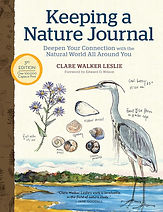
Keeping a Nature Journal:
Deepen Your Connection with the Natural World All Around You
by
Clare Walker Leslie
Getting Started
It's important to make your Field Journal your own special place for recording observations that matter to you. The details of your journal are up to you so choose whatever supplies you like that feel pleasing to you.

-
Select a notebook to use. It can have ruled or blank pages and be any size that works for you. I carry mine in a small bag so I've chosen a smaller size - 5X8 inches. But you might like a larger one.
-
Decide what type of pen or pencil you like to write with. And consider getting a set of colored pencils as well. It's nice to add some color to your drawings.
-
Other items you may find helpful are a small bag or backpack, binoculars, water colors, a technical drawing pen, eraser, clip to help secure pages in the wind, a water bottle.
The Basics
A field journal is not only a record of nature but a place where you reflect on the changes that are happening within you. It doesn't have to be beautiful or perfect--just meaningful for you. A field journal can be kept from a balcony or window; you don't have to travel far to find the nature that is all around you.
-
You may want to visit one place over and over again and record the changes you see there each time. Or carry your journal with you to many different places.
-
Include whatever you like in your journal: maps, poems, postcards, stickers, drawings, questions, memories, leaves, pressed flowers, song lyrics. You are creating this notebook just for you so let it reflect who you are.
-
You don't need to know the names of plants or animals you encounter - just describe them and look them up later.
-
Have the courage to draw badly! Illustrations will deepen your entries and add to the meaning. See the book by Clare Walker Leslie linked to above for excellent tips on how to draw and sketch in your journal.

Setting Up Your Page
Here is a simple way to begin each entry and help you get started. But don't hesitate to change this and make it your own!

-
Date and place
-
Weather and conditions
-
What I notice outside me
-
What I notice inside me
-
What I wonder
-
Add sensory details about sounds, textures, smells, movement, changes you notice, tiny things you might have missed if not for your attentiveness.
-
Close with: Today I am grateful I noticed ...
7 Paths of Wisdom
Hover over each image to read about the practice.

Breathwork is an important practice for calming the nervous system, sharpening focus, and improving mood. Throughout this journey we will use various breathing practices that you will learn as you go, but you can start now using the 4-7-10 technique: -Inhale through the nose for 4 counts -Hold for 7 counts -Exhale through the mouth for 10 counts

You'll need a dedicated journal and a pen throughout this experience. In some cases you may be carrying it with you on a field trip so a smaller notebook could be helpful. It's important to document your reflections and thoughts as you go through this journey. You may discover surprising wisdom there as you read back through your previous entries.

Choose an "observation spot"--preferably a place in nature that is close to home and easily accessible. Visit your spot once every week or so and sit quietly while you observe your surroundings. Take note of what you see and hear, write it down in your journal, draw sketches, press flowers or leaves. Each time you return to this spot notice what has changed and write about it.

Note from Karen
I've spent most of my life in the mountains--wandering on trails, following streams, picking wildflowers, watching birds--always gathering stories and learning life lessons.
When I worked in hospice, as I listened to the stories of my patients and the lessons they were learning at the end of life, I heard the echo of the mountain wisdom that ran in my blood and stirred my soul ... and these 7 Lessons emerged.
Over the years, I have learned that each person brings their own story to these lessons. Again and again, readers have found meanings, resonances, and healing I could not have predicted. That is part of the beauty of this work. The 7 Paths are not meant to tell you what your life means. They are here to help you listen for the meaning already taking shape within you.
Karen

Explore Another Path
Choose what you'd like to work on next by clicking on the corresponding image below:




You are here